
Scientific Approach
Canovum addresses a fundamental challenge in difficult veterinary cases: the evidence is often fragmented, prior conclusions may conflict, and no one has unlimited time to reconstruct the entire case. Our scientific approach brings the available evidence together, tests what is actually supported, identifies what remains unresolved, and develops an evidence-supported proposed path forward for veterinary review.
Complex Cases. Fragmented Evidence.
Evidence in a difficult canine case may be generated across multiple practices, specialists, laboratories, imaging providers, and years of treatment, yet it rarely remains connected as one coherent investigation.
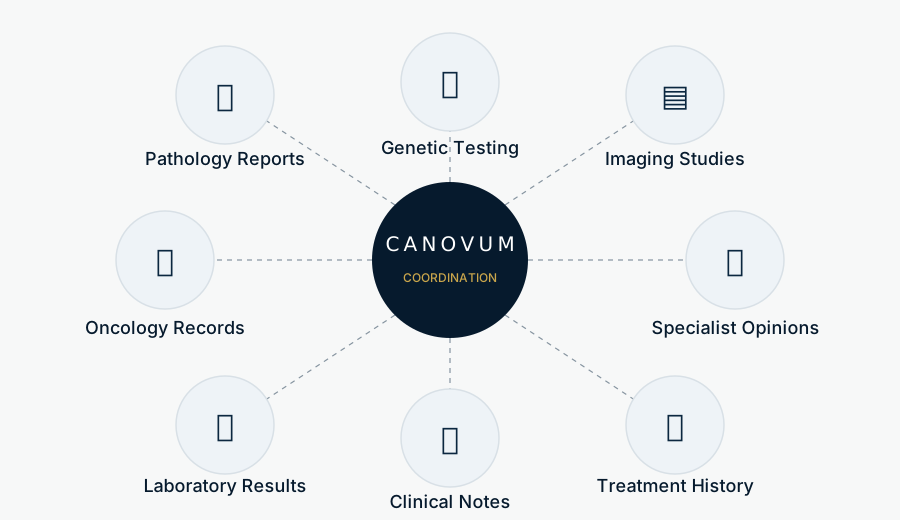
Medical records, pathology, imaging, laboratory results, treatment history, specialist opinions, original source data, and owner observations may tell different parts of the story. Canovum begins by finding and reconnecting those parts before asking for anything new.
Reconstruct What Actually Happened.
Canovum reconstructs the case as a chronology of evidence: what was observed, what was tested, what the evidence showed, what was concluded, what treatment followed, and what happened next.
The process connects pathology, imaging, laboratory trends, treatment history, specialist findings, source evidence, and owner observations while preserving where each piece of information came from.
Contradictions, missing information, unsupported assumptions, and differences between source evidence and prior interpretation are made explicit rather than silently carried forward.
Ask the Next Question That Matters.
Canovum does not ask an AI model to read a case and simply produce an answer. The investigation proceeds through a structured reasoning process that evaluates evidence, competing explanations, contradictions, unresolved questions, and possible next actions.
At each stage, the question is not “What else can we test?” but “What information could materially change the path forward, and do we already possess evidence capable of answering it?” Computational and AI systems provide speed, breadth, and persistence within that process; credentialed veterinary professionals provide clinical review and authority.
Evidence & Contradictions
Track supporting evidence, conflicts, uncertainty, and missing information.
Information Value
Prioritize the unresolved question most likely to change the pathway.
Scientific Investigation
Search literature, prior treatment response, relevant therapies, and comparable evidence.
Veterinary Review
A credentialed veterinarian reviews the proposed pathway and its supporting evidence.
From Investigation to a Proposed Path Forward.
The objective of the investigation is not a generic summary or an automated diagnosis. It is an organized, evidence-supported proposed path forward that makes the supporting evidence, meaningful uncertainties, and relevant alternatives visible for veterinary review.
The proposed pathway is reviewed by a credentialed veterinarian and brought back to the treating veterinarian for consideration. When the existing evidence cannot answer a genuinely pathway-changing question, Canovum can identify what additional information may be worth obtaining, but additional testing is an exception rather than the starting point.
Every Case Can Strengthen the Next.
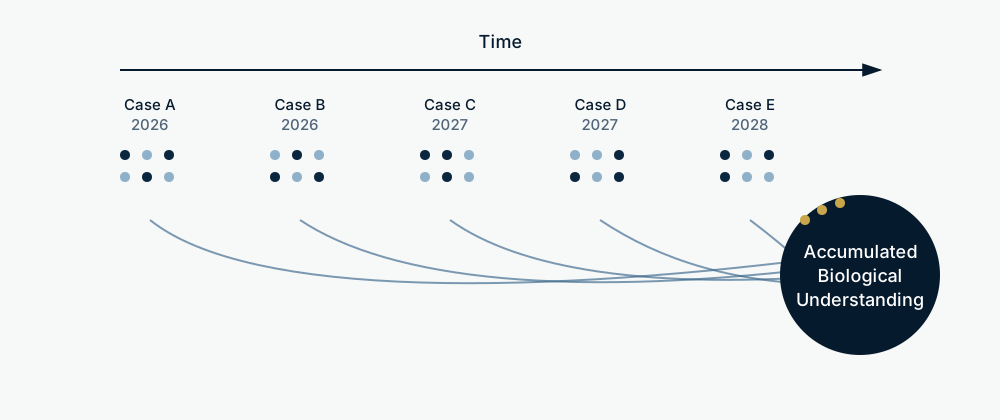
With appropriate permission, Canovum can preserve what the investigation learned over time: which evidence mattered, which questions changed the pathway, what treatment followed, how the dog responded, what the owner observed, and what happened next.
That growing longitudinal case library can improve future investigations without turning any prior case into a shortcut for the next one. Each new dog is investigated on its own evidence, while benefiting from the structured experience accumulated before it.
Every dog deserves the benefit of everything we have learned from every dog that came before it.

Help Us Pressure-Test Canovum
Canovum is preparing for initial case validation and is pressure-testing the investigative, clinical-review, evidence-handling, and veterinarian-handoff model before live case use.
We welcome conversations with veterinarians, veterinary specialists, researchers, diagnostic laboratories, and scientific collaborators willing to challenge the approach and help identify where it could fail.
CONTACT CANOVUM →