How Canovum Works

Canovum investigates difficult canine cases by gathering the evidence that already exists, reconstructing the complete case, and searching for scientifically defensible paths that may not have been considered.

Start With Everything We Already Know

Difficult canine cases rarely exist in one place. Records may span primary-care practices, specialty hospitals, emergency visits, diagnostic laboratories, imaging providers, and years of treatment. Important information may also exist only with the owner.

Canovum does the legwork to bring that evidence together: veterinary records, treatment history, pathology, laboratory findings, imaging and original source data where obtainable, specialist opinions, and structured owner observations.

More testing is not the starting point. The starting point is understanding the evidence that already exists.

Reconstruct the Case

Canovum organizes the accumulated evidence into a coherent case history: what happened, when it happened, what was observed, what was tested, what was concluded, what treatment followed, and what happened next.

Conflicting terminology, missing records, contradictory findings, unsupported assumptions, and overlooked evidence are identified rather than silently carried forward.

Investigate, Don't Just Summarize

Canovum investigates the case systematically, examining the evidence, challenging assumptions, identifying unresolved questions, searching relevant scientific literature, evaluating treatment history, and exploring scientifically defensible pathways across available veterinary and other relevant evidence.

Canovum has no preferred drug, laboratory, manufacturer, diagnostic technology, or type of treatment. The investigation follows the evidence.

The Canovum Workflow

From Fragmented Evidence to a Path Forward

Each case moves through a disciplined investigative process designed to extract as much value as possible from existing evidence before asking for anything new.

01

Gather the Existing Case

Collect records, pathology, laboratory findings, imaging, treatment history, specialist opinions, available raw evidence, and structured owner observations from across the dog's care.

02

Reconstruct What Happened

Build the chronology, reconcile terminology, connect evidence across providers, identify missing information and contradictions, and distinguish established facts from assumptions.

03

Investigate the Case

Examine hypotheses, overlooked evidence, scientific literature, treatment history, available therapies, clinical trials, and other evidence-supported possibilities relevant to the individual dog.

04

Ask Only What Still Needs Answering

Existing evidence comes first. If an unresolved question genuinely prevents a defensible path forward, Canovum determines whether a targeted reread, specialist interpretation, raw-data reanalysis, or, when truly necessary, additional testing could change the decision.

05

Credentialed Veterinary Review

The proposed pathway, supporting evidence, unresolved uncertainties, and relevant alternatives are reviewed by a credentialed veterinarian before the investigation is brought back to the treating veterinarian.

06

Return the Pathway

Canovum returns an organized, evidence-supported proposed path forward for consideration with the treating veterinarian, who remains central to the dog's care and clinical decisions.

07

Learn What Happened

With appropriate permission, treatment decisions, owner observations, patient response, quality of life, and outcomes become part of the longitudinal case record so future investigations can benefit from what this case taught us.

The Canovum Collection & Evidence Kit

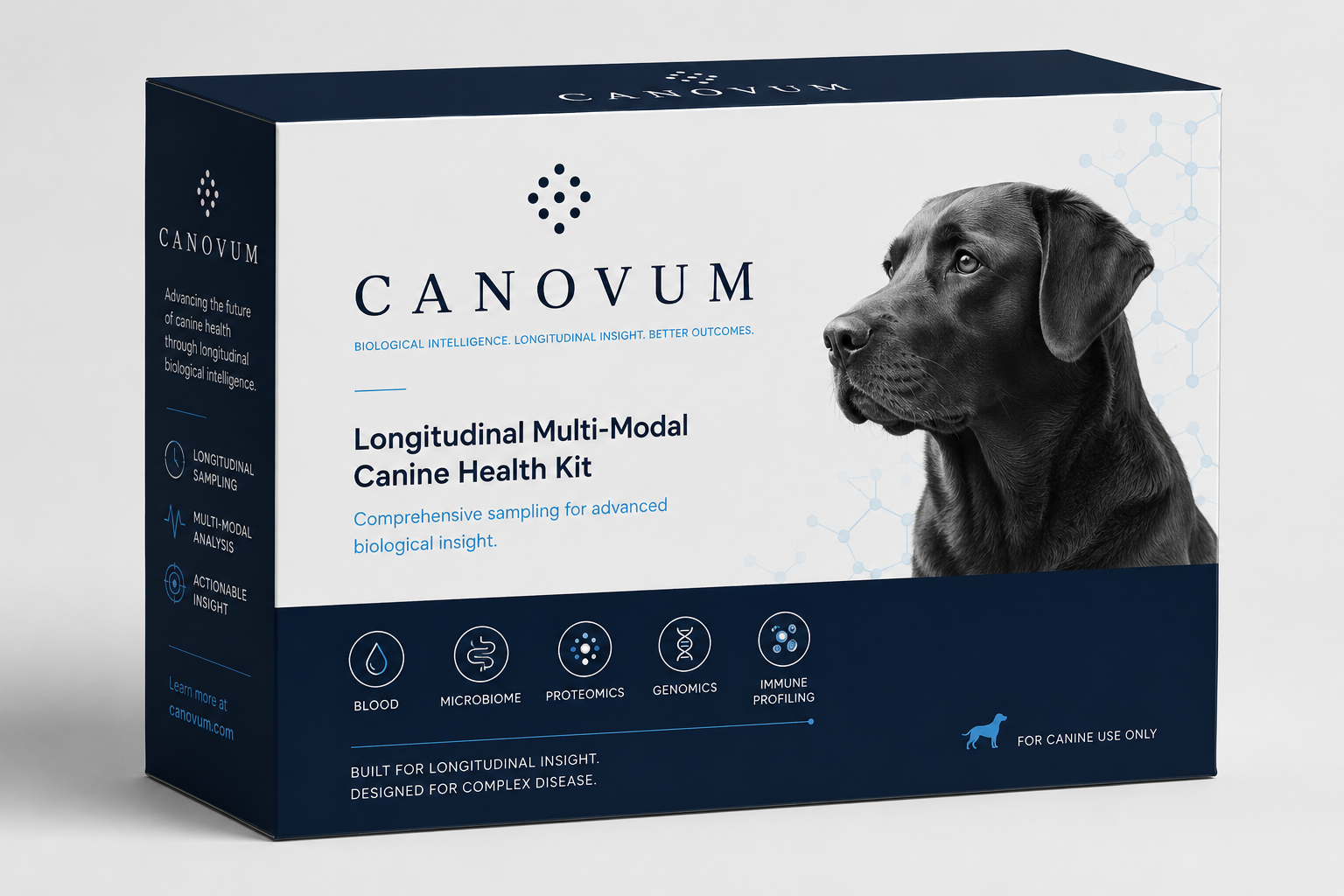
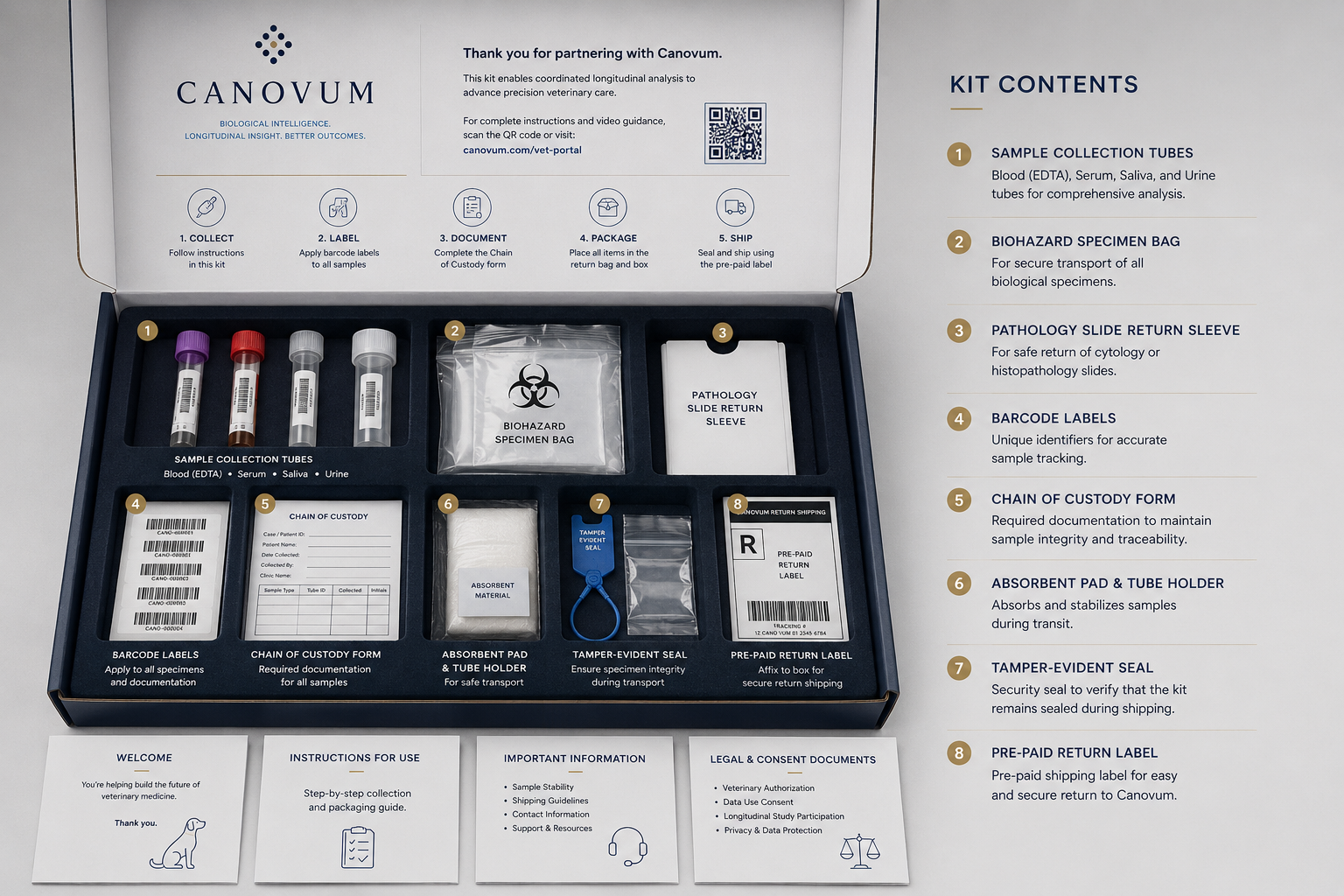
The Canovum kit connects the digital investigation to the physical evidence behind the case. When existing slides, tissue blocks, biological samples, or other physical evidence need to move between veterinary practices, laboratories, and specialists, the kit provides a standardized way to keep that evidence tied to the correct case.

Pre-associated identifiers, documentation, secure packaging, chain-of-custody controls, and coordinated shipping help preserve evidence integrity while reducing administrative burden on the veterinary practice.

The kit is not a mandate to collect more samples. Its first job is to help Canovum safely recover, preserve, and move evidence that already exists.

Canovum Collection and Evidence Kit

Preserving and Moving Physical Evidence

Physical evidence can be scarce, perishable, or difficult to replace. Canovum's evidence-preservation workflow is designed to maintain identity, traceability, specimen condition, documentation, and appropriate handling as material moves through the investigation.

Whenever possible, Canovum also seeks to preserve reusable digital evidence such as whole-slide pathology images, original DICOM imaging, genomic files, and other underlying source data so the same evidence can be reviewed again without unnecessary recollection or repeat testing.

If the existing evidence cannot answer an important pathway-changing question and new material is genuinely necessary, the same system can support standardized collection and preservation. But additional collection is an exception, not the starting point.

Inside the Canovum Collection and Evidence Kit

Every Case Strengthens the Next

Difficult veterinary cases are often evaluated in isolation. Valuable information about what was known, what was tried, why decisions were made, how the dog responded, and what the owner observed can become fragmented or disappear over time.

With appropriate permission, Canovum preserves that information as structured longitudinal evidence. Over time, the accumulated case library can improve comparative intelligence, investigative methods, and our ability to recognize patterns that may be difficult to see in an isolated case.

The goal is simple: every dog should have the opportunity to benefit from what Canovum has learned from the dogs that came before it.

Help Us Pressure-Test Canovum

Canovum is preparing for initial case validation. Before live case use, we are pressure-testing how the investigation works in the real world: evidence acquisition, clinical review, specialist interaction, owner follow-up, physical evidence handling, and the handoff back to the treating veterinarian.

We welcome conversations with veterinarians, veterinary specialists, researchers, diagnostic laboratories, and scientific collaborators who are willing to challenge the model, identify where it could fail, and help us build a rigorous way to investigate difficult canine cases.

Contact Canovum
Dog Portrait